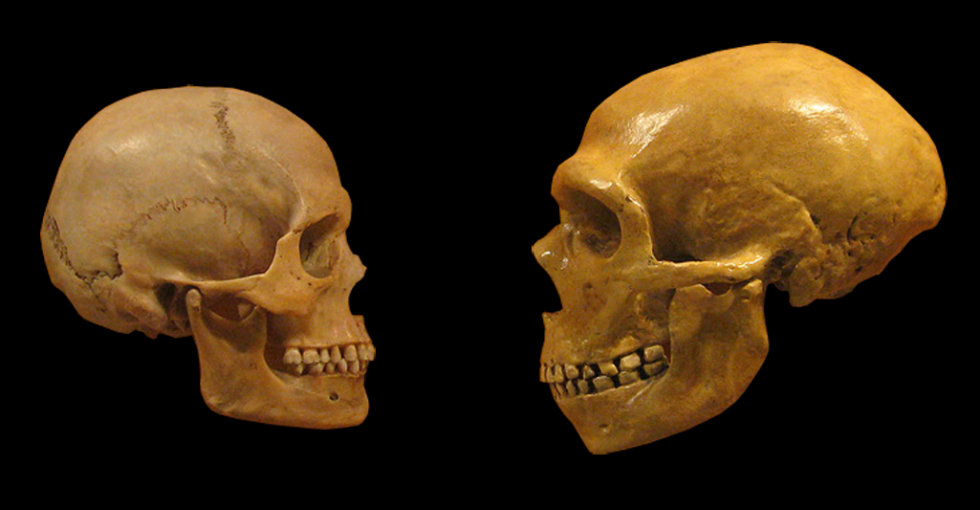
Neanderthal brains were, on average, larger than those of modern humans. That fact alone upends the outdated myth of Neanderthals as knuckle-dragging simpletons. But if their brains were just as big—if not slightly bigger—why didn’t they dominate the planet the way Homo sapiens eventually did? The answer lies not in volume, but in structure, organization, and how brains translate into behavior.
This isn’t just a curiosity of paleoanthropology—it’s a challenge to how we define intelligence, adaptability, and evolutionary success.
Brain Size Doesn’t Equal Smarts—Here’s Why
It’s tempting to assume that bigger brains mean greater intelligence. After all, humans have the largest brains relative to body size among primates. But nature is full of counterexamples. Sperm whales have brains five times heavier than ours, yet they don’t build cities or write symphonies. Elephants and dolphins have complex social structures and problem-solving abilities, but their brain architecture differs significantly from ours.
In the case of Neanderthals (Homo neanderthalensis), average cranial capacity was about 1,520 cubic centimeters—slightly larger than the modern human average of 1,350–1,450 cc. This data comes from endocasts—moldings of the inside of fossilized skulls—that give scientists a rough map of brain shape and volume.
But volume doesn’t reveal everything. What matters more is: - Neural density - Cortical folding (gyrification) - Regional specialization - Connectivity between brain areas
A larger brain might simply mean more neurons dedicated to visual processing or motor control—not higher cognition. In fact, research suggests Neanderthals had larger occipital lobes (vision centers), possibly an adaptation to lower-light environments in Ice Age Europe. That leaves less neural real estate for other functions—like social coordination or abstract planning.
How Scientists Measure Ancient Brain Capacity
Estimating brain size in extinct species relies on indirect methods. Since brains don’t fossilize, researchers use cranial endocasts—natural or digital molds of the inner skull surface. These reveal: - Overall brain volume - Approximate shape - Impressions of major sulci and gyri
Techniques like CT scanning and 3D modeling now allow precise reconstructions. For example, the Amud 1 Neanderthal skull, discovered in Israel, has an estimated cranial capacity of 1,740 cc—well above any modern human average.
But limitations exist: - Endocasts don’t show internal structure (e.g., white matter tracts) - Skull thickness can skew volume estimates - Post-mortem deformation may distort shape
Despite these issues, the consistency across dozens of Neanderthal specimens confirms one thing: their brains were physically comparable in size to ours.
Structural Differences That May Have Changed Everything
Size aside, brain organization likely differed between Neanderthals and modern humans. Studies comparing endocasts suggest key distinctions:
| Feature | Neanderthals | Modern Humans |
|---|---|---|
| Occipital lobe | Enlarged (vision) | Smaller relative to total brain |
| Parietal lobes | Flatter, less expanded | More rounded, expanded |
| Cerebellum | Slightly smaller | Larger, especially posterior portion |
| Frontal lobes | Similar size, possibly less interconnected | Highly developed integration |
The parietal expansion in Homo sapiens is critical. This region handles sensory integration, spatial reasoning, tool use, and symbolic thought—functions tied to complex language and culture.

A 2018 study published in Nature Communications used MRI and fossil data to model brain development in Neanderthals. It found that modern human infants undergo a unique “globularization phase” in early brain growth, leading to a more spherical brain shape. Neanderthals lacked this phase, suggesting developmental differences from birth.
These structural divergences may explain why Homo sapiens developed widespread symbolic art, long-distance trade, and cumulative technology—while Neanderthals, despite making tools and using fire, left behind far less cultural complexity.
Cognitive Abilities: What Neanderthals Could (and Couldn’t) Do
Calling Neanderthals “primitive” is misleading. Evidence shows they were capable of: - Burial of the dead (Shanidar Cave, Iraq) - Use of pigments and ornaments (Spanish cave shells with drilled holes) - Complex toolmaking (Mousterian toolkit, requiring multi-step planning) - Hunting large game (mammoths, bison, using coordinated tactics)
They even interbred with modern humans—leaving 1–4% Neanderthal DNA in non-African populations today. That implies social contact, communication, and likely some shared cognitive ground.
But there are clear gaps: - No undisputed cave art created solely by Neanderthals (despite claims at La Pasiega) - Minimal evidence of ritual or symbolic storytelling - No long-term resource storage or agriculture - Limited long-distance exchange networks
One telling example: modern humans in Europe created intricate bone flutes and figurative carvings 40,000 years ago. Neanderthals, who lived in the same region just millennia earlier, left no such artifacts. The tools they used were efficient—but static. There was little innovation over tens of thousands of years.
This suggests a cognitive ceiling: Neanderthals were intelligent, but not cumulatively cultural. They could learn and adapt, but not build knowledge across generations the way Homo sapiens did.
The Social Brain Hypothesis: Why Networks Beat Brain Size
One compelling theory for human dominance is the social brain hypothesis. It argues that human intelligence evolved primarily to manage complex social relationships—not to solve ecological problems.
Modern humans live in larger, more interconnected groups. Even in prehistoric times, evidence suggests Homo sapiens formed alliances across distant bands, exchanged goods, and shared information. This required advanced language, theory of mind, and trust.
Neanderthals, by contrast, lived in smaller, isolated groups. Isotope analysis and genetic studies suggest limited mobility and low population density. Their smaller social circles may have reduced the evolutionary pressure for advanced communication or symbolic systems.
Think of it like computing power: having a larger hard drive (brain size) doesn’t help if your operating system (social structure) can’t run complex programs. Neanderthals had the hardware, but perhaps not the software.
What Genetics Reveal About Brain Development
DNA is rewriting the story of Neanderthal cognition. Sequencing of Neanderthal genomes has identified key gene variants linked to brain development that differ from modern humans.
Notable examples: - NOVA1: A gene involved in neural development. The Neanderthal version produces different splicing patterns, potentially altering synaptic connections. - TKTL1: A gene linked to frontal lobe neuron production. A single amino acid difference in modern humans may increase neuron count in the developing neocortex. - FOXP2: Once thought unique to humans, Neanderthals had a similar version—suggesting some capacity for speech, though perhaps less nuanced.

A 2022 study in Science introduced the Neanderthal variant of TKTL1 into mouse embryos and organoids (lab-grown brain tissue). The result? Fewer neurons formed in the neocortex—hinting at a biological basis for cognitive differences.
This doesn’t mean Neanderthals were “dumber.” But it does suggest their brains developed differently—possibly prioritizing different functions.
Why Brain Size Alone Misleads Evolutionary Thinking
The Neanderthal brain paradox exposes a deeper issue in how we judge intelligence. We’re biased toward our own success. Because Homo sapiens survived and Neanderthals didn’t, we assume we were “better” in every way.
But Neanderthals thrived in harsh Eurasian climates for over 300,000 years—longer than anatomically modern humans have existed. They were physically stronger, adapted to cold, and likely excellent survivalists.
Their extinction likely resulted from a mix of factors: climate change, competition with expanding Homo sapiens, small population size, and possibly assimilation—not lack of intelligence.
Yet we focus on brain size as a proxy for worth. That’s a dangerous oversimplification. Intelligence isn’t a single trait. It’s a constellation of abilities shaped by environment, culture, and biology.
What This Means for Understanding Human Uniqueness
The fact that Neanderthal brains measured up to ours—literally—forces a reevaluation of human exceptionalism.
We weren’t the only hominin with a large brain. We weren’t the only one capable of emotion, tool use, or social bonds. But we were the only one to develop hyper-connected societies, symbolic language, and explosive technological change.
The difference may not lie in raw processing power, but in how information is shared, stored, and built upon across generations. Our brains may be optimized for cultural transmission—not just individual problem-solving.
So when we say Neanderthal brains were as big as ours, we should ask: What kind of intelligence does a big brain actually produce—and under what conditions does it lead to long-term success?
Closing Thought: Brain size is just the first chapter in the story of cognition. The real narrative lies in connectivity, culture, and the ability to innovate collectively. Neanderthals had the volume—modern humans mastered the network.
FAQ
Did Neanderthals have bigger brains than humans? Yes, on average, Neanderthal brains were slightly larger in volume than those of modern humans.
Does bigger brain size mean Neanderthals were smarter? Not necessarily. Brain organization, connectivity, and cultural transmission matter more than size alone.
What did Neanderthals use their brains for? Evidence suggests strong visual processing, motor control, and survival skills—especially in hunting and adapting to cold climates.
Could Neanderthals speak? They likely had some form of vocal communication. Genetic evidence (FOXP2) supports speech capacity, though perhaps less complex than modern language.
Why did Neanderthals go extinct if their brains were so big? Extinction was likely due to a combination of climate shifts, competition with Homo sapiens, small population size, and limited cultural innovation—not brain size.
Do we have Neanderthal brain genes today? Yes, non-African populations carry 1–4% Neanderthal DNA, including genes linked to brain development and function.
Can we recreate a Neanderthal brain? Not fully, but scientists are using brain organoids with Neanderthal gene variants to study developmental differences in lab settings.
FAQ
What should you look for in Neanderthal Brains Were as Big as Ours—What That Really Means? Focus on relevance, practical value, and how well the solution matches real user intent.
Is Neanderthal Brains Were as Big as Ours—What That Really Means suitable for beginners? That depends on the workflow, but a clear step-by-step approach usually makes it easier to start.
How do you compare options around Neanderthal Brains Were as Big as Ours—What That Really Means? Compare features, trust signals, limitations, pricing, and ease of implementation.
What mistakes should you avoid? Avoid generic choices, weak validation, and decisions based only on marketing claims.
What is the next best step? Shortlist the most relevant options, validate them quickly, and refine from real-world results.